I have had the pleasure of knowing Cyndi Lord mostly through social media. We are both participants in an annual charity event hosted by Tammy Thompson called Gathering of Authors and held in Texarkana. The event raises funds for St. Jude Children’s Hospital and Arkansas Children’s Hospital.
When I learned Michelle Dalson featured Cyndi in an author interview I was determined to read it. Cyndi has leveraged experience as a private investigator and criminal justice professional to become a best selling paranormal mystery author.
This post discusses Cyndi’s background, providers writing advice and important information on marketing your book.
I hope you enjoy this as much as I.
AUTHOR INTERVIEW with Cyndi Lord: Advice for Planning, Writing, and Marketing Your Book
Filed under Uncategorized
Review of Behold the Dawn, by K.M. Weiland
Compelling and riveting historical fiction
Get ready for a novel by KM Weiland that will grab you and hold on until you turn the last of its captivating pages.

Behold the Dawn, by K.M. Weiland
Behold the Dawn opens in the year 1192 when Crusaders under King Richard I battled Saladin’s Muslim forces in the Holy Land in an attempt to recapture Jerusalem. At the same time, Marcus Annan engaged in deadly mock battle as a Tourneyer. Annan, “…fought today for the same reason he always fought: it was the only thing his life had left him fit for.” Under threat of excommunication, tourney participants such as Annan continued to ply their trade.
Excerpt from the tourney
The setting sun, burning gold through the dust of the field, glinted against the iron tip of a war hammer. Annan’s blood pumped heat into his muscles. The rules of this tourney banned the war hammer from competition; its lethal heft would crush armor and shatter flesh and bone alike. His fist tightened on his sword hilt, the leather finger of his gauntlet creaking against the steel of the crossguard. Marcus Annan wasted no mercy on duplicitous knaves.
After a day of dealing death, he’s troubled by the sight of a faceless monk, a face hidden within the shadow of a cowl. By the time the spark of recognition brought flashes of hidden memories from 16 years past, the monk disappeared. Annan collected his spoils and ransom from battle while a chain of unfolding events propelled him from Bari, Italy to the fields of battle in the Holy Land.
Annan and his sidekick Peregrine Marek, a Scottish lad indentured to his service, would face deadly challenges from former comrades at arms in addition to threats from avowed enemies. A onetime believer in Christianity, Annan now felt his soul beyond hope; a conscience seared from a life running away from a nightmare called St. Dunstan. Gethin the monk, also known as the Baptist, raged against the Church, the Pope, the Holy War and especially against Roderic the Bishop. These words resurrected memories of the tragic day as he had tried to forget all those years.
During an encounter with Roderic and men at arms allied with him, Annan agrees to kill a former colleague by the name of Matthias, but refuses to kill William, Earl of Keaton his former mentor, his wife Lady Mairead, and the Baptist. By doing so, events are set in motion that take Annan and Marek to the Holy Land.
Not long after landing on the beaches of Acre, Annan and Marek found themselves in the heat of battle, tasting victory as Crusader catapults breached the walls of Acre. Just when the battle appeared to be won, Saladin’s cavalry breached the flanks of Christian fighters. Annan took an arrow from a Saracen volley as it passed through his mail shirt. A Moslem blade disemboweled Annan’s mount. Annan fell, the world around him faded. When Annan woke, he found himself in a prison camp in the care of Knights Hospitalers and in the presence of Lady Mairead the Countess of Keaton, wife of William of Keaton. Annan is one of 2,500 prisoners. Eventually, Annan gained an audience with William after making a plea to Mairead. During that meeting, a dying William made a daunting request, a request to escort Mairead from the Holy Land to a convent in Orleans, France.
Annan accepts the request that will lead to a series of attacks on Annan and Mairead. The story progresses through a series of narrow escapes. Enemies abound. Friends die. Mystery compels constant diligence. Mairead, a deeply religious Christian, prays for Annan, not for his life only but that he accept God’s redemption. While doing so, barriers she had placed between them, fade. Her persistence causes him to question his lack of faith. Maybe there is hope after all.
KM Weiland thoroughly researched the period then used her amazing gift of expression and talents of turning the right phrase and delivering memorable quotes. Readers become part of the field of battle, experience thrilling suspense, and visualize colorful tapestries as she paints poetic word pictures of earth, sky and sea.
Excerpt, lyrical text
This was the fortress city of Jaffa, its repaired walls dark against the sunset red of the sea, pinpricks of early firelight just beginning to show through the window slits in the wall.
I’ve read and enjoyed other novels and short stories by KM Weiland and have a new favorite in Behold the Dawn.
In addition to writing wonderful fiction, Ms. Weiland has written back to back, award winning books on the writing craft, Outlining Your Novel and Structuring Your Novel. Refer to her author biography for a complete listing of her work.
K.M. Weiland Biography

K.M. Weiland Author, mentor and blogger
K.M. Weiland lives in make-believe worlds, talks to imaginary friends, and survives primarily on chocolate truffles and espresso. She is the IPPY and NIEA Award-winning and internationally published author of the Amazon bestsellers Outlining Your Novel and Structuring Your Novel, as well as the western A Man Called Outlaw, the medieval epic Behold the Dawn, and the portal fantasy Dreamlander. When she’s not making things up, she’s busy mentoring other authors on her award-winning blog http://www.helpingwritersbecomeauthors.com. She makes her home in western Nebraska. Find out more about her fiction at http://www.kmweiland.com.
Why I write:
Stories are like breathing. Life without a story in my head is one-dimensional, stagnant, vapid. I love the life God has given me, but I think I love it better because I’m able to live out so many other lives on the page. I’m more content to be who I am because I’m not trapped in that identity. When I sit down at my computer and put my fingers on the keys, I can be anyone or anything, at any time in history. I write because it’s freedom.
Writing routine:
I set aside two hours, five days a week, to write, usually between four and six p.m. I’m a firm believer in Peter de Vries claim: “I write when I’m inspired, and I see to it that I’m inspired at nine o’clock every morning.” I spend the first half hour scribbling ideas in a writing journal, reviewing character sketches and research notes, reading an article on the craft, and proofreading what I wrote the day before. Then I pick a soundtrack, say a prayer for guidance, and dive in.
Process:
It takes years sometimes for my ideas to find their way onto the page. After the first kernel of inspiration takes root, I play with it and play with it, discovering characters and scenes and plot twists. Finally, when I think it’s ready, I dig out a notebook and start sketching ideas and outlines. Depending on the subject matter, I spend a few months researching, then take a deep breath and pray that all the work will pay off in a way that will glorify God.
Inspiration:
Most of my story ideas begin with a character and a place. An outlaw in the Wyoming Territory. A mercenary knight in the Crusades. A vigilante plantation owner in Kenya. A female spy in the Napoleonic Wars. A barnstormer in early 20th-century Kansas. After that, who knows? Inspiration is a gift from God: bits and pieces, tiny ideas that bloom into unexpected treasures.
Advice:
Writing is both a gift and an art. As a gift, it must be approached with humility: the writer is only the vessel through which inspiration flows. As an art, it must be approached with passion and discipline: a gift that’s never developed wasn’t worth the giving.
Website: http://www.kmweiland.com/
Writing advice: http://www.helpingwritersbecomeauthors.com/
Amazon.com Author Page: Link
Smashwords: Link
Filed under Book Review, Historical Fiction, Writing
August 16th Denton Poets’ Assembly Meeting Announcement
 Reblog: Announcing the Denton Poets’ Assembly August 16th meeting – Join us from 10 a.m. – Noon at the Emily Fowler Public Library in Denton for readings of poetry based on a lesson last month by J. Paul Holcomb on Heroes.
For the complete article click here.
Filed under Uncategorized
July 19th Denton Poets’ Assembly Meeting Announcement
Greetings poets and lovers of poetry. Join us from 10 a.m. – Noon at the Emily Fowler Public Library in Denton for readings of poetry based on last months lesson by J. Paul Holcomb titled, “The Rondel,” a fourteenth century French form with characteristics similar to the villanelle and triolet.
For the complete post, click Here.
Filed under Uncategorized
Denton Poets’ Assembly Meeting Announcement & Chapter News
 Denton Poets’ Assembly will meet again 10 a.m. – Noon on June 21st at the Emily Fowler Public Library in Denton, Texas. Guests are welcome and encouraged to bring a favorite poem to read. Members will be reading a Stretched Sonnet based on J. Paul Holcomb’s lesson on the subject last month.
Members and guests will be given an opportunity to read a free choice poem.
We look forward to J. Paul Holcomb’s poetry lesson this month. Members will vote on DPA chapter officers for the year 2014-2015.
Lucinda Breeding, Features Editor for The Denton Record Chronicle recognized three DPA poets and their pairings in the days and weeks that followed the reception…
For additional information about the event, click here.
Filed under Poetry, Recognition, Writing
76th Anniversary of D-Day, the Normandy Invasion— A Day to Remember
June 6, 1944
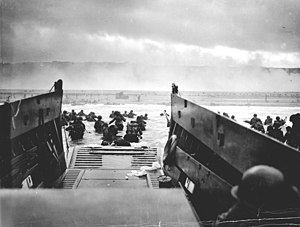
A LCVP (Landing Craft, Vehicle, Personnel) from the U.S. Coast Guard-manned USS Samuel Chase disembarked troops of the U.S. Army’s First Division on the morning of June 6, 1944 (D-Day) at Omaha Beach. (Photo credit: Wikipedia)
It’s been said, “Freedom isn’t free.” The Normandy Invasion, commonly called DDay, signaled the beginning

of the end of Nazi tyranny and freedom in Europe. Of those who fought there, few remain to tell their stories. It is fitting that we continue to honor their sacrifices and heroism.
Allied forces consisting of American, British and Canadian troops made up the main invasion force of over 160,000 ground combatants. Allied Navy and merchants ships numbered more than 5,000. Ships provided transportation and gunfire support during the invasion. At midnight before the amphibious assault, Allied Aircraft and gliders inserted almost 8,000 paratroopers behind enemy lines. This represented the largest armada and invasion force in history. Weather and timing were critical to the success of the mission, so was deception. It had taken nearly five years to reach this point in a war that began in September, 1939 with the invasion of Poland by Nazi forces. This truly was the start of the liberation of Europe. Total Allied casualties were approximately 12,000; again, freedom isn’t free. At Pointe du Hoc, German 155mm guns threatened assaults on Utah and Omaha beaches.
There’s a Texas connection to the Normandy invasion that can’t be ignored. I am quoting an article from the Texas State Historical Association about the Second Ranger Battalion commander, James Earl Rudder. This battalion played a pivotal role in success at Omaha and Utah Beaches:
Rudder’s Rangers fight with distinction on Normandy beaches
James Earl Rudder commanded the Second Ranger Battalion on DDay, as it achieved one of the
Modern day view of Pointe du Hoc, Normandy (Photo credit: Wikipedia)
great feats of arms of the Normandy invasion. Rudder, a native of Eden, Texas, had served in the army in the 1930s and was recalled to duty during World War II. He became commander and trainer of the elite Second Ranger Battalion in 1943. On D-day Rudder’s Rangers stormed the beach at Pointe du Hoc and, under constant enemy fire, scaled 100-foot cliffs to reach and destroy German gun batteries. The battalion suffered higher than 50 percent casualties, and Rudder himself was wounded twice. In spite of this, he and his men helped establish a beachhead for the Allied forces. In later life Rudder became president of Texas A&M. In 1967 he received the Distinguished Service Medal from President Lyndon Johnson.
Ronald Reagan’s Speech on the 40th Anniversary of D-Day
Delivered at Pointe du Hoc Youtube Video, Ceremony Commemorating the 40th Anniversary of the Normandy Invasion, D-Day 6/6/84

Related Handbook Articles:
Other Resources:
http://en.wikipedia.org/wiki/Normandy_landings
http://en.wikipedia.org/wiki/Normandy_landings
§

Allied invasion plans and german positions in the Normandy. (Photo credit: Wikipedia)

Preinvasion bombing of Pointe du Hoc by 9th Air Force bombers. (Photo credit: Wikipedia)

English: Convoy on its way to support the Normandy invasion. (Photo credit: Wikipedia)
Related articles
Filed under Liberation of Europe, Normandy Invasion, Word War 2
Special Announcement: Poetry Society of Texas Anthology

Purchase link from Denton Poets’ Assembly webpage.
Reblogged from the Denton Poets’ Assembly website.
Poets and lovers of poetry,
I’m honored to announce the publication of A Texas Garden of Verses: An Anthology,
an e-book celebrating poems and poets from the 2013 PST Summer Conference. It is the product of contributions DPA made to the conference. Eight DPA members are in this anthology; Karona Drummond, J Paul Holcomb, Beth Honeycutt, Chris Irving, Angie Kimmell, Annie Neugebauer, Jan Spence and Jervis Underwood. Chris Irving also helped edit the e-book along with the summer conference committee.
For the complete article with purchase information, click Denton Poets’ Assembly webpage.
Filed under Poetry, Recognition, Texas, Writing
May 17th Denton Poets’ Assembly Meeting Announcement and Chapter News
Denton Poets’ Assembly will meet again 10a.m – Noon on May 17th at the Emily Fowler Public Library in Denton, Texas. Guests are welcome and encouraged to bring a favorite poem to read.
Denton Poets’ Assembly last met on Saturday April 19. During the meeting, members read a Cinquain poem based on our March lesson. J. Paul Holcolmb presented a lesson on the sonnet. He will present a lesson on the “Stretched Sonnet” this Saturday.
Quoting J. Paul, I wanted to do it this month because Roberta Bowman came up with the innovation and her funeral was last week. This will be remembering her in a literary way. Also, it will follow the lesson on sonnets so folks should have something to stretch.
Members and guests also read free choice poems in April.
Continued: For the complete post, click here.
A Tribute to Mothers Everywhere
A Tribute to Mothers Everywhere on this Mother’s Day Weekend − It is all about recognizing the love and sacrifice by the one who gave us life, to our spouses and our daughters. To all mothers in my family and friends who are mothers, I want to honor you with this tribute. May you have a wonderful Mother’s Day!

Mother’s Day Tribute
Filed under Uncategorized
Thoughts on The Resurrection
My friend and author, Thomas Drinkard posted an article with compelling arguments for the Resurrection and Christianity; arguments well worth sharing. I hope you read and give it thoughtful consideration.

I’ve posted this before, but now—on Good Friday—it seems appropriate to think about the Resurrection deeply.
~~~~~~~~~~~~~~~~
After the Resurrection, the Romans—as well as those in the Jewish hierarchy who opposed Jesus and his ministry—said that his disciples had stolen his body away from the tomb. It came about when the chief priests bribed the soldiers who had guarded the tomb.
Matthew 28 tells the story:
1 After the Sabbath, at dawn on the first day of the week, Mary Magdalene and the other Mary went to look at the tomb.
2 There was a violent earthquake, for an angel of the Lord came down from heaven and, going to the tomb, rolled back the stone and sat on it. 3 His appearance was like lightning, and his clothes were white as snow. 4 The guards were so afraid of him that they shook and became like dead men.
View original post 1,619 more words
Filed under Uncategorized


 Rich Weatherly - Author